'Zephyr <3 Internet: How Zephyr Speeds Implementation for New IoT Devices by Jonathan Beri'
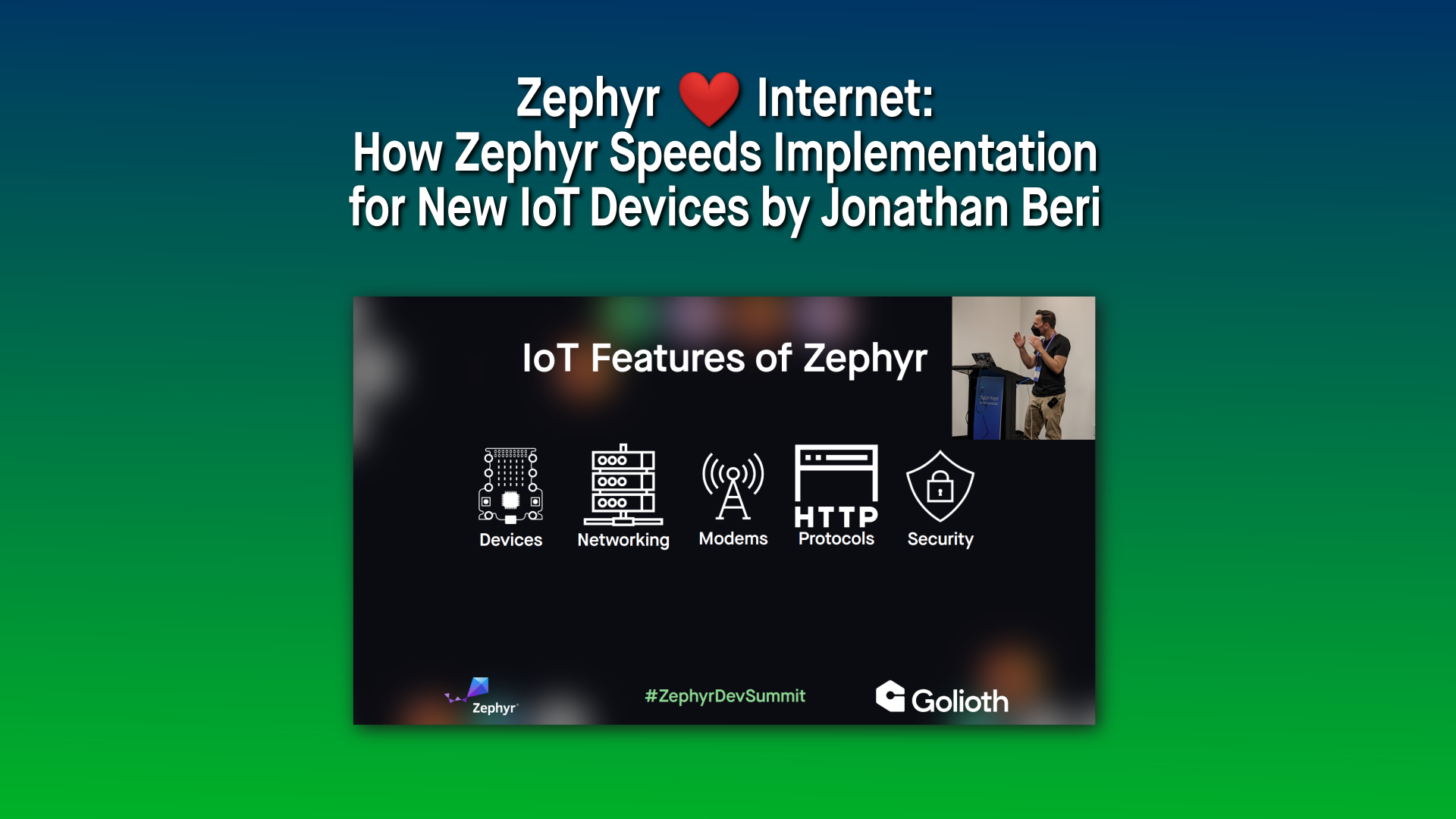
Golioth Founder and CEO Jonathan Beri gave a talk at the 2022 Zephyr Developer Summit (ZDS) about how Zephyr can help you create an IoT product faster.
It’s no secret that we like Zephyr Real Time Operating System (RTOS) around here. Nor is it a secret that we’re very interested in the Internet of Things (IoT). Golioth Founder and CEO Jonathan Beri gave a talk at the 2022 Zephyr Developer Summit (ZDS) about why those two things are a perfect match, and how Zephyr can help you create an IoT product faster.
A high level overview
Since this talk was on the first day of ZDS, it was focused on people less familiar with the Zephyr ecosystem. So what should a beginner know about Zephyr and its relationship to IoT devices?
Batteries are included
Zephyr has a couple of key features that makes it a “one stop shop” for building an IoT device. Some other RTOSes rely on the engineer to piece together libraries and implementations to get started, which either means more startup time or reliance on hardware vendors to make a ready-to-go solution for you. Instead, Zephyr provides individual elements already configured to work together:
- Device drivers
- An OS kernel (including scheduler)
- Services
- A build system Tying together the ecosystem with these tools provides a consistent experience. This also leads to another very important aspect.
Chip vendor buy-in
Because Zephyr has a well defined system, the chip vendors develop code to make their parts work within the ecosystem. With other RTOSes, that script is flipped; the RTOS is made to work with abstraction layers within the vendor specific ecosystem, meaning there is less likelihood of interoperability with other vendor solutions. In addition to the chipsets from the vendors, a wide range of boards are supported. Targeting specific boards makes it easier to get dev boards working when getting started, and remapping pins to specific functions on a board doesn’t require a configurator tool like those available in many vendor IDEs.
Talking to the Internet
If you choose an RTOS that isn’t a broader ecosystem, you need to either define your own network layers or lean on a vendor implementation to do it for you. In Zephyr, the network layer and the protocol definitions are done as a part of the community. That means that chip, module, and software vendors are all working towards a common implementation. Add in the fact that there are modems and abstraction layers all the way up the stack, and an engineer using Zephyr doesn’t need to think about all of the pieces it takes to connect to the internet. At Golioth, we are able to switch between various networking technologies easily when using Zephyr.
Protocol Variety
Golioth talks to the internet at a very high level, so network access “just works”. This comes into focus as a small embedded device can talk to the variety of internet protocols available. Most people understand HTTP, but also consider the more common IoT favorites like MQTT and CoAP. Golioth favors CoAP but also supports MQTT. This enables implementations in other parts of the network stack. A good example is devices running OpenThread, a Thread network protocol implementation. As we showed in our recent post about Thread, a small Zephyr-based device utilizes 6LoWPAN and talks over CoAP using UDP packets to talk back to the Golioth cloud.
Last but not least: Security
Zephyr enables a secure connection back to the internet through the network stack and with features like DTLS, the basis of a secure connection over UDP. Security is a deeper topic in Zephyr though, all the way down to secure bootloaders and working within things like TrustZone. Talking to secure elements requires drivers that understand how to communicate with particular chip features (internal or external to a microcontroller). At a very high level, Zephyr focuses on things like Software Bill of Materials (SBOM), so your security teams understand the various software you are pulling into the build.
Built for IoT
Zephyr not only ❤️ internet…it’s purpose built for enabling IoT devices. Paired with Golioth, a Zephyr device has a higher likelihood of getting to market and growing to a massive scale. We’d love to hear your thoughts about the video on our Forum, our Discord, or by email.