Organizing thousands of connected devices
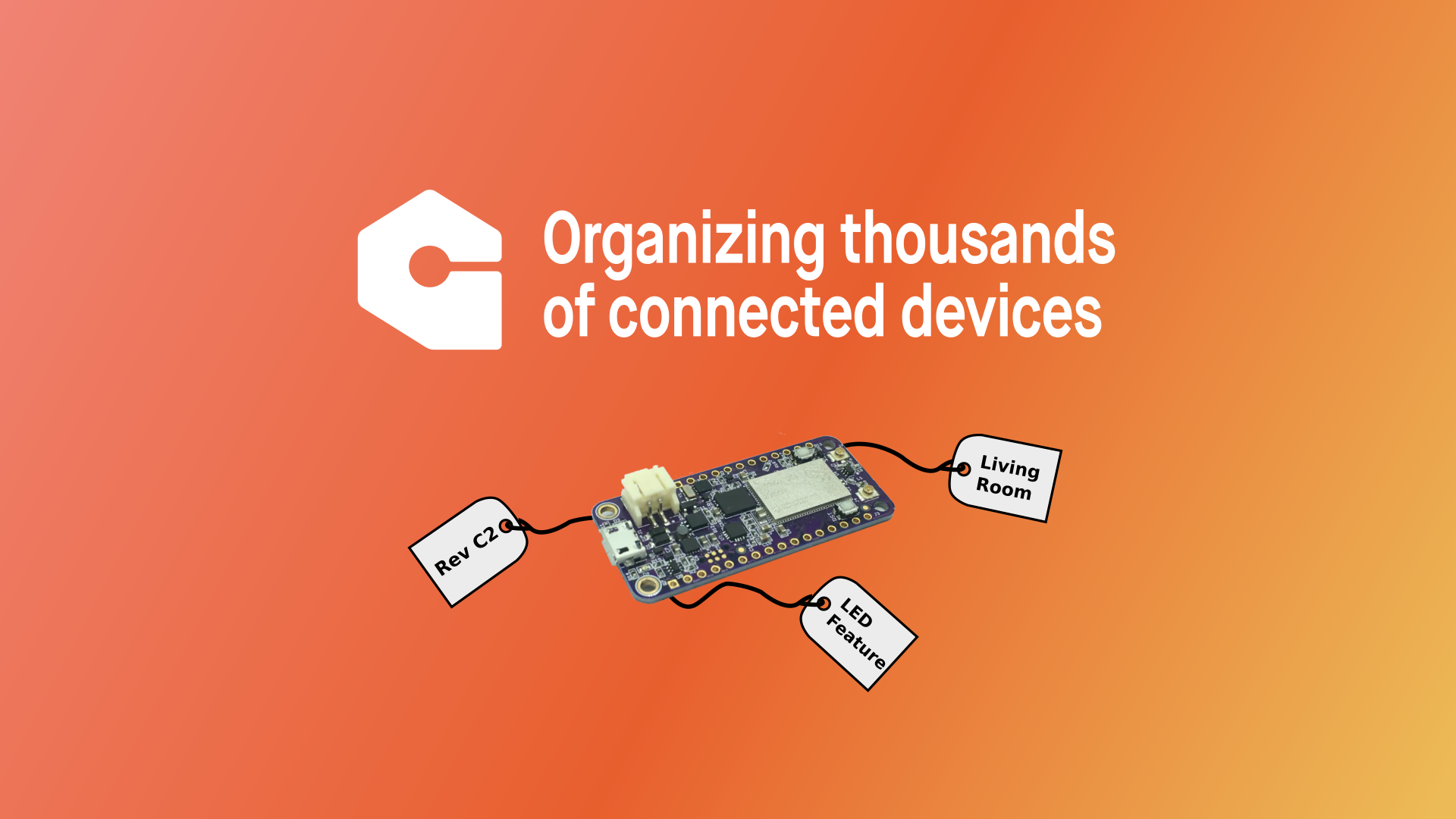
Golioth tags make large deployments more manageable, offering different insights into where and how IoT devices can be accessed and updated.
Scaling makes things more difficult
As your deployments grow, things start to get messy.
- You need to add lots of new devices to your network
- You have to maintain firmware updates for all the devices on your network
- You have to organize all of the devices on your network At 100, or maybe even just below 1000 devices…you can do it however you’d like. You might have a spreadsheet listing the location of devices and all of the relevant information about them. But even then, it is a full-time job to manage devices. What’s more, as new people come in to take action on particular devices, they need to slice and dice the data about where the device is located, its status, the capabilities that the device has.
According to Satistia in 2021, there are more than 13.8 billion active IoT devices. It’s estimated that the number of active IoT devices will surpass 30 billion by the end of 2025.
A good organizational system will reduce mistakes
Planning and organizing will help you get your work done accurately while avoiding costly mistakes. Managing this huge number of devices requires a good organizational system. Golioth provides a simple solution to manage devices: tags. Tags provide a flexible, flat hierarchical structure in which you can group multiple devices. We are going to explore the usefulness of tagging in the Golioth platform.
Why use tags?
A tag is a simple text, generally, one to three words, that provides details about a device. The tag is assigned to a unique device on the Golioth network. Later, when searching, it is a simple click or search term in order to locate similar devices with the same tag. You can easily separate your devices with any criteria you choose. For example, a separation between development devices and production devices. This can be useful when you want to change configurations for a specific set of devices. By using tags, you can group these devices and push the needed configuration using something like the OTA DFU on the nRF91. You can also group different devices depending on your deployments or regions. Maybe you’re building an asset tracker application and you want to separate your devices that are on the east coast of the US vs the west coast. Or maybe you want to only update devices that are in a particular time zone. Or even separate when you push an update based on timezone, preferring to push firmware when no one is actively using the device. With tags, it’s possible to target firmware update deployment where and when you want it.
Flat structure
Right now, Golioth tags are a flat structure. You can assign multiple tags to a device without the concept of hierarchy. Even with this flat structure, it’s possible to do some powerful things like we just described. For example, using tags with LightDB allows us to pull or send data to specifically tagged devices. If you want to toggle an LED on a group of devices, you can send the new state to that group by sending the command to the associated tag, as shown in the video below. This is practical for test purposes. You can manipulate a device’s tags graphically on the console, or you can use the Golioth Command Lines Interface (CLI) to remove, add, or modify certain tags. The CLI in particular can be really useful as you start to have a deployment that’s much bigger (hundreds, thousands, millions). When you’re ready to retrieve data from groups of devices, you can also query data and even do aggregations using tags. For example, if you want to see the average temperature of devices located on the 3rd floor in a factory, you could filter the logs for “factory”, “3rd floor”, “temperature” and then aggregate the data. Extending this idea, pulling data from tagged devices in a region could even lead to a sort of ad-hoc mapping.