How to Provision and Store IoT Device Certificates
Every IoT device should operate over an encrypted channel. But how exactly does that security work as your fleet rapidly grows? Our recommendation is to use certificate authentication to deliver strong encryption while solving common fleet management problems. Today we’re showing how to provision and store IoT device certificates.
Certificate Authentication based on ECDSA
Golioth uses ECDSA encryption. You generate a root certificate and private key, use that key to sign all of your device certificates, then upload your public root certificate to Golioth. The last piece of the puzzled is placing a unique device certificate onto each device. One method of doing so is to store the cert on a filesystem in non-volatile storage (NVS) that is separate from the firmware itself. Golioth has sample code to show you how, and that’s the subject of today’s video.
Root and Device Certificates
Generating the certificates is beyond the scope of this post, but the process is well-documented in the certificate authentication section of the Golioth docs. As a result of this process you will upload the generated public root certificate to Golioth. This lets Golioth securely connect to any device that uses certificates signed by your private root key. Every device you put into the field needs to have a unique public/private key pair signed by your private root key. That device key and device certificate is what we store on the device file system.
Storing Device Certificates in a File System
Zephyr RTOS includes a filesystem which we have turned on in
our certificate-provisioning sample code. Once the firmware is flashed to the device, use the Zephyr shell to create a directory in which the credentials are stored. This directory creation process can be further automated (through an mcumgr command or perhaps with some clever initialization in the firmware) but we chose to leave this as a manual step so that it’s obvious what is happening under the hood. Credentials are transferred to the device over a USB connection using mcumgr because it facilitates writing to the filesystem over the serial connection. This is a separate process from updating the firmware, which means you can change the firmware without altering the device certificates. Likewise, you can update the certificates without overwriting the firmware.
Golioth Automatically Provisions Your Devices
We often discuss
the security benefits of using certificates instead of pre-shared key authentication. But from a fleet-management standpoint there’s another huge benefit to doing so: automatic cloud provisioning for your devices.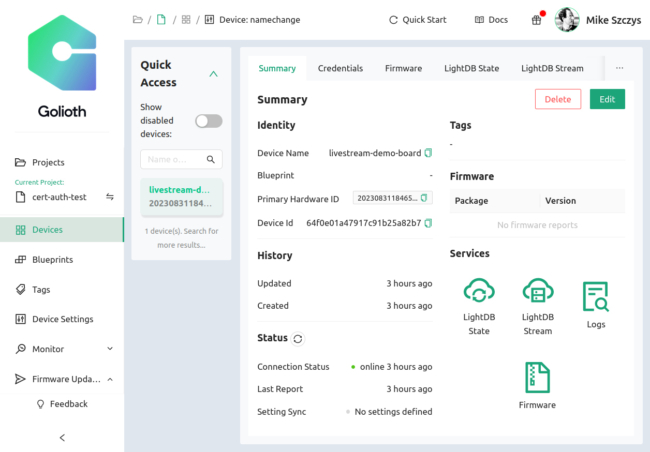
Test Out Provisioning and Storing IoT Credentials Now!
Your first 50 devices are free with Golioth’s Dev Tier. Take your test drive today and see how smooth and powerful the provisioning process can be!