Embedded Rust with Golioth and the Nordic nRF9160
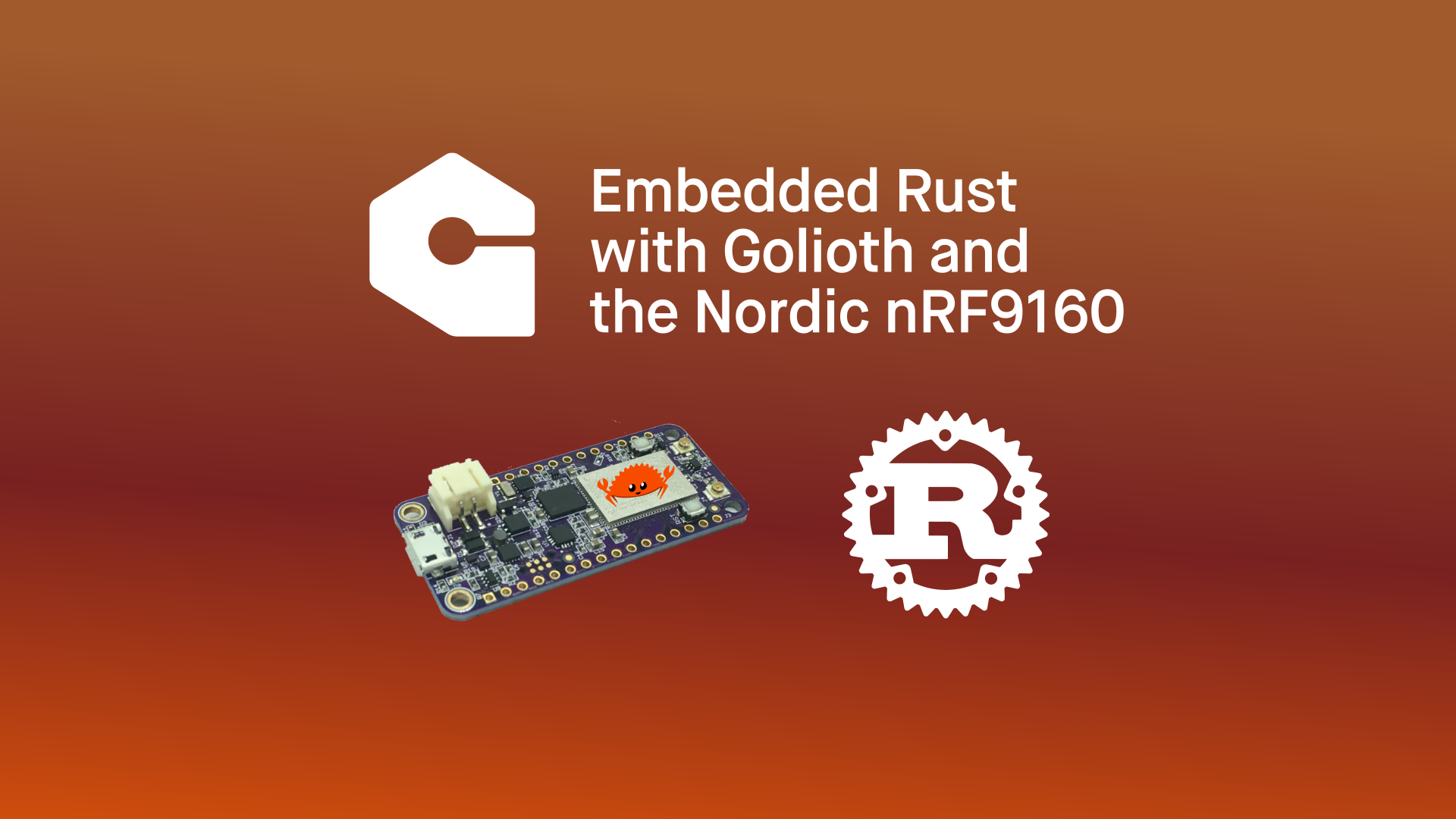
Team members Lachlan and Chris discuss an implementation of a Rust code sample with Golioth and the Nordic Semiconductor nRF9160. There is a demo of the code working in the video attached below.
What is Rust?
Rust is a high-level, general-purpose programming language, syntactically similar to C and C++. It is fast and memory-efficient and is specifically designed for performance and safety. It has no runtime or garbage collector, while taking advantage of the higher-level concepts and safety guarantees. Rust can run on embedded devices, and can be easily integrated with other languages, and is ideal for performance-critical services. Rust is still in early days of development, starting in 2010 and only coming to embedded devices a few years ago. The developer community around Rust is passionate and growing. While Rust and C/C++ share similarities, Rust is relatively faster than C/C++ in some cases. Rust also has the benefit of a package management system, which makes implementing different libraries easier than C (which existed long prior to the internet). Easy package management encourages code reuse by allowing libraries to be readily integrated into applications, not to mention building the overall community around Rust.
Why we’re trying it
Golioth was interested in trying out Rust as part of our Golioth Labs segment on GitHub, where the code is currently hosted. It represents one of many trials we have and will take on in order to showcase the Golioth platform. We are committed to showing ways to access Golioth services and APIs outside of our normal recommended path Golioth SDK based on Zephyr RTOS. Not only does this represent the reality for many users, it also showcases how Golioth services are accessible from many different programming paradigms, in addition to a wide range of hardware. Another good example from Golioth Labs is our Arduino SDK discussed in our last article. We chose to try Rust on the nRF9160 because the hardware represents a key product on the platform. This Nordic part has great support from Golioth and Nordic Semiconductor, and is listed as “Verified + Quickstart” on the Golioth Hardware Catalog. While the quickstart is using Zephyr to get users up and started, it is a well-supported part internally at Golioth. The nRF9160 is also primed for Rust integration: Nordic Semiconductor provides a library for the NRF devices that exposes the API which communicates with the hardware. There is also a Rust binding for it which makes it quite easy to implement the rust code and enables you to connect to Golioth servers and send and receive data. In addition, Rust has some code abstraction features and doesn’t require a debugger.
Video explanation and demonstration
In the demo below, Lachlan shows how he is able to use the library and bindings to connect over CoAP to the Golioth servers and replicate many of the functions that exist in Golioth samples.